Featured Work
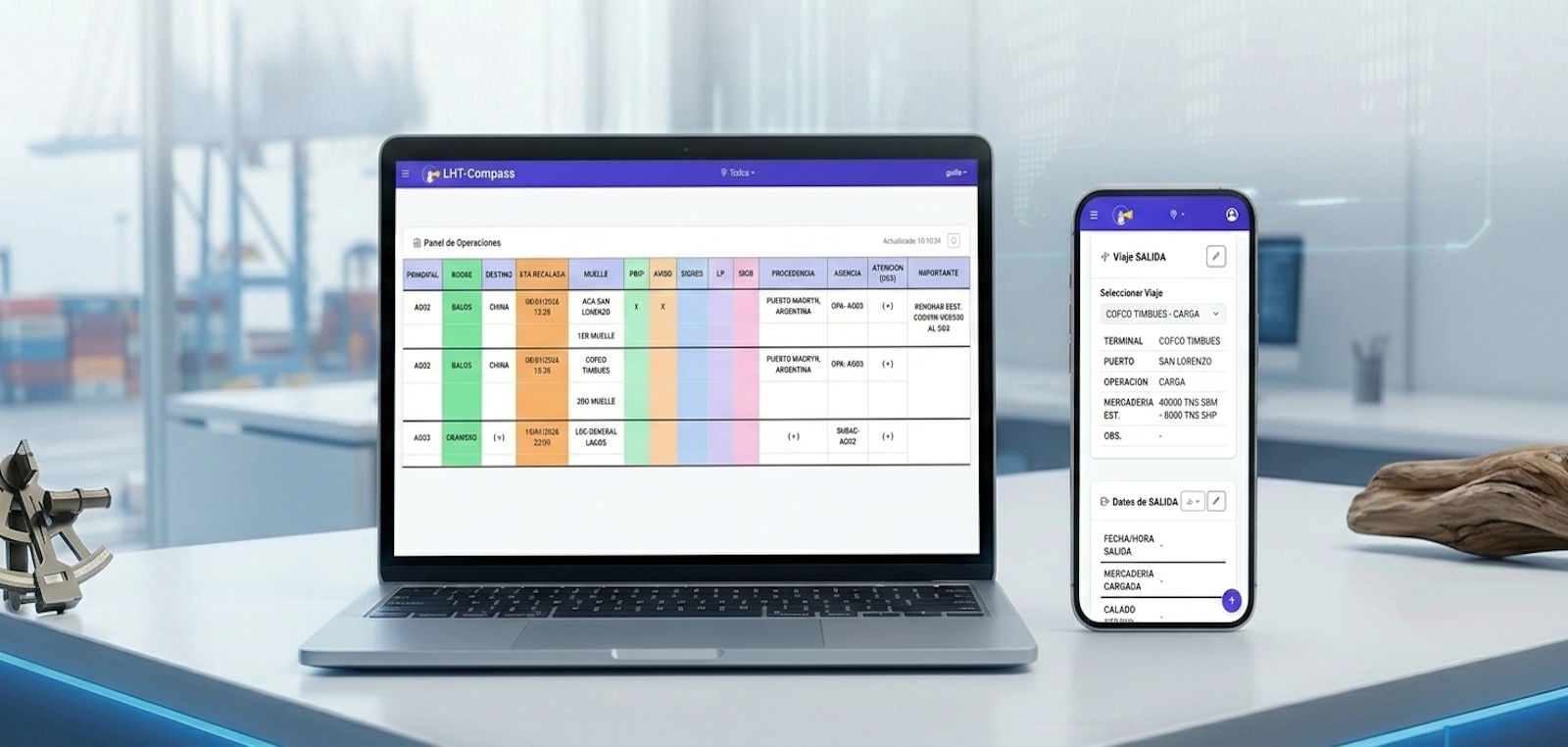
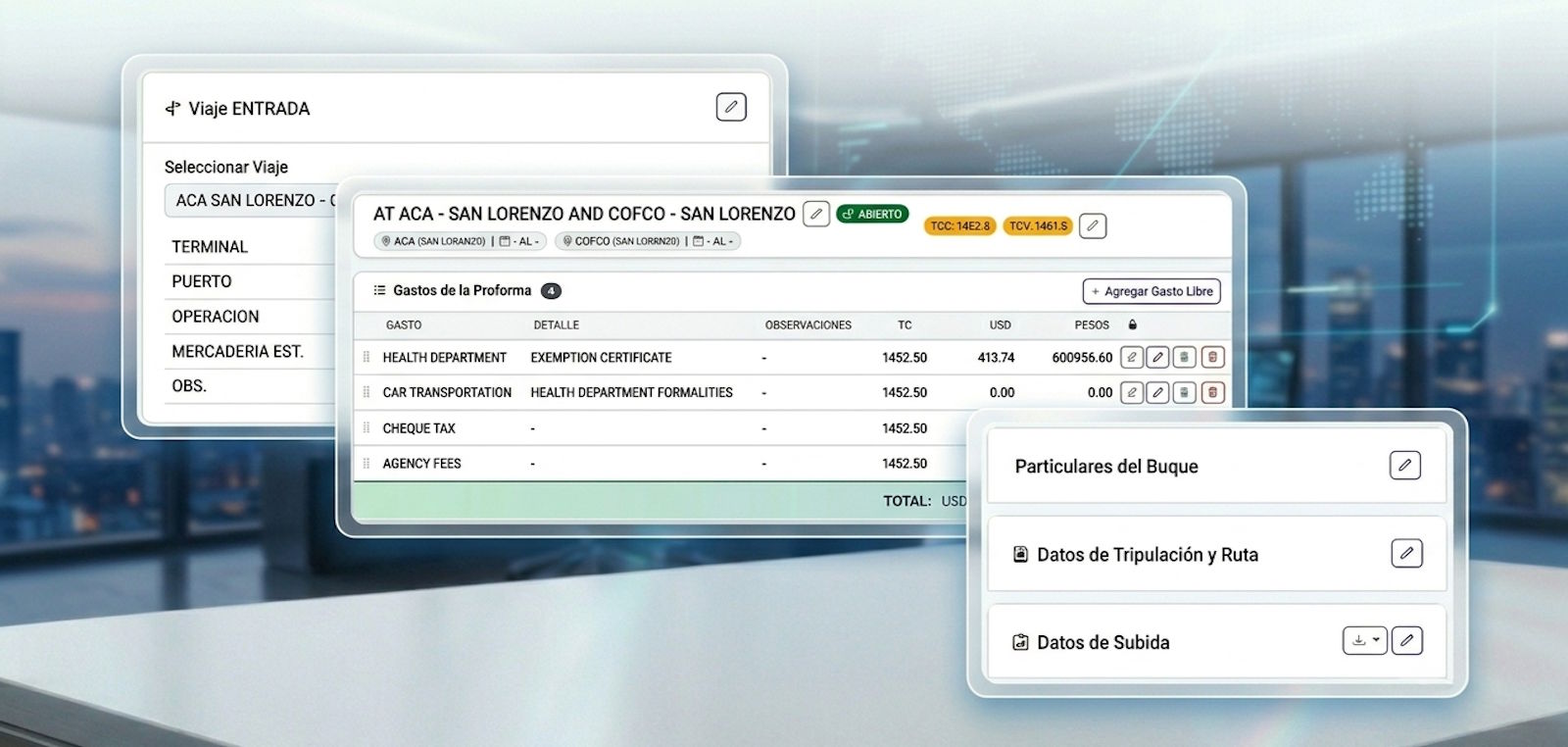
Web platform built to centralize and organize the maritime agency business. It provides real-time visibility of each operation, managing vessel nominations and documentation, and issuing expense reports (PDAs).
Web platform with multi-device access
Objective
- Centralize operational and administrative information
- Real-time tracking of vessels, voyages, and operations
- Reduce errors and management time
Benefits
- Quick identification of each operation's status
- Better coordination between operational and administrative teams
- Financial control through per-operation expense tracking
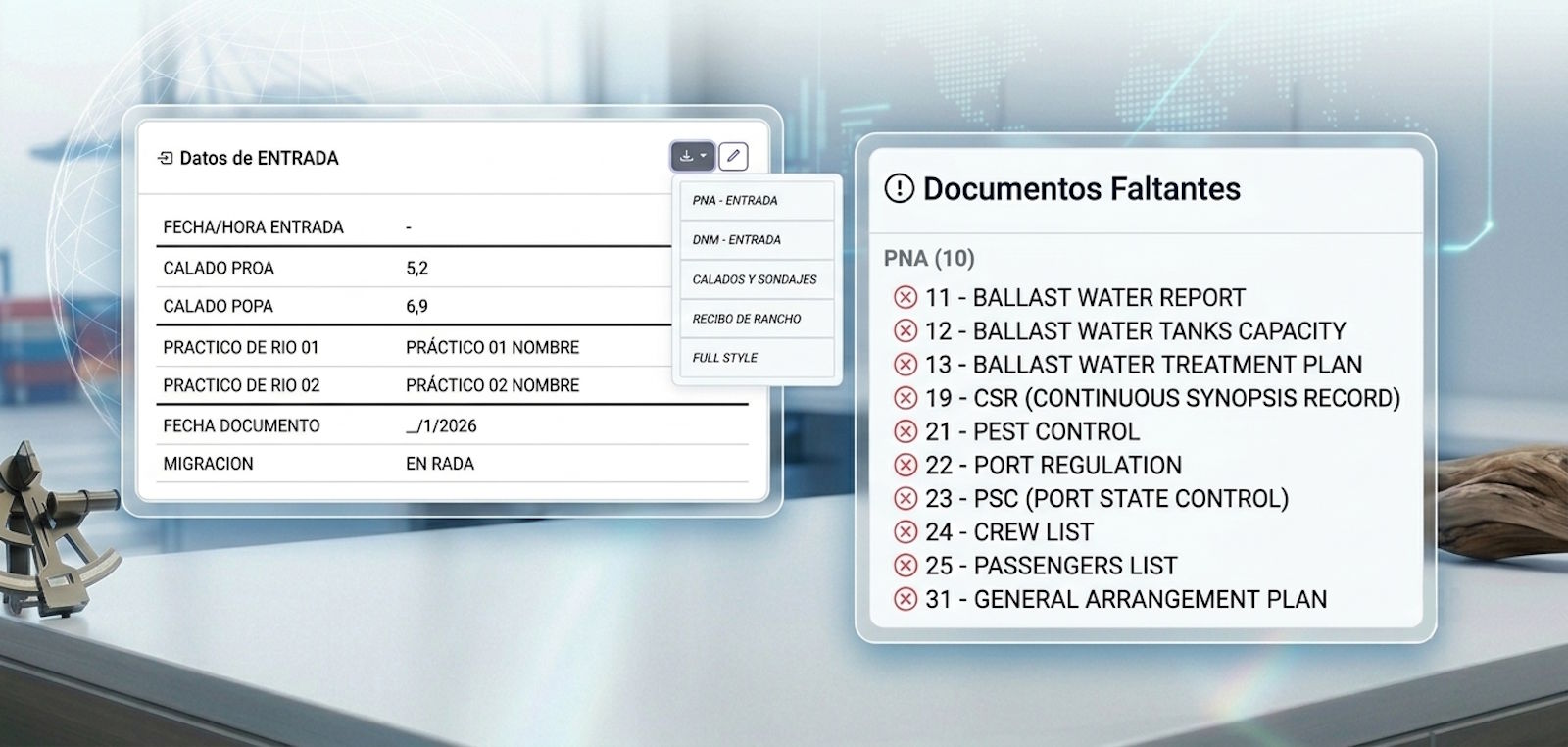
- Automatic document generation for port and government entities
- Complete history and instant access to information
Scalability
- Solid foundation for future operational, administrative, and accounting modules
- Adaptable to different ports and operational volumes
- Aligned with real maritime business processes
Real Business Knowledge
With over 15 years of experience tied to maritime agency administration, a deep understanding of the industry's operational challenges was developed. After years of using generic solutions and working with external developers that failed to adapt to the real needs of day-to-day operations, the need arose to build a custom alternative.
What started as a desktop accounting tool oriented to the administrative reality of the business evolved into a web platform built with Django, where the focus shifted to operational management. That combination of industry experience and software development constitutes the main differentiator: not only is technology built — the logic of the business is also understood.
Internal web application designed and developed covering the full project cycle: business discovery with real users, modeling, application architecture, full-stack implementation, security hardening, and deployment.
Stack
- Backend: Python + Django 6.0
- Database: PostgreSQL in production, SQLite in development
- Frontend: Bootstrap 5, Bootstrap Icons, vanilla JavaScript (Django SSR + interactive JS)
- Static files: WhiteNoise
- Document generation: fillpdf, pdfrw2, PyMuPDF, fpdf, openpyxl (PDF and Excel)
- Utilities: num2words (amounts to Spanish text), qrcode, Pillow, pdf2image
- Configuration: python-dotenv (.env), dev/prod separation via DJANGO_ENV
Security & authentication
- Mandatory 2FA via django-otp (TOTP, compatible with Google Authenticator)
- Protection against malicious attacks with django-axes (lockout after failed attempts)
- Custom middleware:
LoginRequiredMiddleware(global mandatory login) andSingleSessionMiddleware(one active session per user) - Production hardening: SSL redirect, HSTS, secure cookies, CSRF trusted origins, strict ALLOWED_HOSTS
- Groups and permissions:
@admin_requiredgate for admin functions, 403 JSON responses for AJAX - Secrets outside the repository (.env)
Application architecture
- Project modularized into apps by business domain: home (base, utilities, mixins), usersAuth (auth, OTP, profile), parameters_general / administration, operations (operational core), exports
- "One feature → one app" rule: each domain with its own models, URLs and templates
- View sub-packages (
views/core.py,views/docs_agencia.py,views/documents.py) to group related concerns and ease maintenance
Internal design patterns
- Standardized CRUD: three views per entity (list, ajax, delete) with shared helpers (
ajax_save,ajax_delete) centralizing validation, IntegrityError handling and messages - Generic base template (
parameter_list.html) that each CRUD extends overriding blocks:page_title,table_headers,table_body,form_fields - Unified server↔client contract:
form_initial_jsonserializes forms usingForm.Meta.fieldsas source of truth;populateFormfills modals by input name - Concurrency: generic
RecordLock(ContentType) with 10-min TTL and warning at 2 min. Prevents simultaneous edits without blocking reads UppercaseFieldsMixinfor data normalization at model level, not form level
Coding style & conventions
- Imports always at the top of the file, except for circular-import conflicts or lazy loading
- Identifiers and comments in English; UI, messages and
verbose_namein Spanish (localized UX) - Reusable validations centralized in
home/utils(e.g.validate_cuitfor Argentine CUIT) - Forms:
ModelFormwith explicit Bootstrap widgets, preferringexcludeover explicit fields lists so the form evolves automatically with the model - JS in separate files (
static/js/<app>/), loaded viaextra_scriptsblock in each template - Global CSS with only minimal strictly-necessary additions
Highlighted features
- Automatic generation of official documentation (PNA, DNM, terminals) filling official PDF forms with operation data
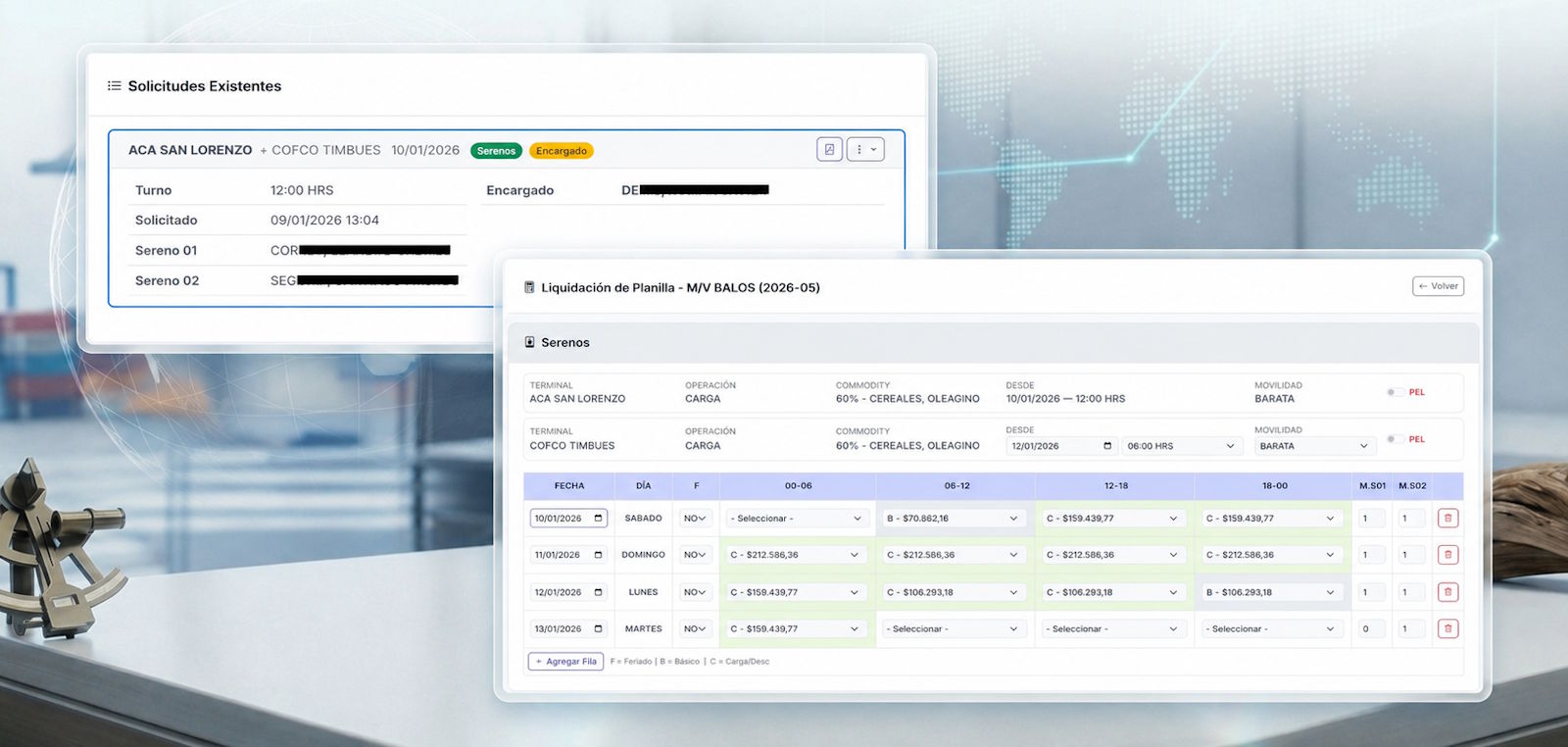
- Temporary personnel payroll with automated calculation
- Expense reports (proformas) per operation/voyage
- Operations dashboard with real-time view of each vessel/voyage status
- Bulk parameter import via
manage.pycommands with versioned CSV files (ports, terminals, vessel types, etc.)
Web application with an integrated landing page. Enables management of import and export operations with automatic generation of the required documentation.
Operational Management
- Centralized information and easy access
- Tracking the status of each operation
- Streamlined oversight
- Reduction of errors and administrative time
Document Automation
- Automatic document generation:
- - Load finalization
- - Shipping declaration
- - Export delivery
- - Packing list
Web application with an integrated landing page covering the full project lifecycle: requirements gathering with the broker's real workflow, customs domain modeling, architecture, full-stack implementation, security hardening and deployment.
Stack
- Backend: Python 3 + Django 4.2 (LTS) + Django REST Framework 3.15
- Database: MySQL in production, SQLite in development
- Frontend: Bootstrap 5, Bootstrap Icons, vanilla JavaScript
- Document generation: FPDF, fillpdf, PyMuPDF
- Utilities: jQuery, Moment.js, qrcode, Pillow, pdf2image
- Deployment: cPanel webhosting (Passenger WSGI), .com.ar domain registration
- Configuration: python-dotenv (.env), dev/prod separation via
DJANGO_ENV
Security & authentication
- Mandatory 2FA via django-otp + django-two-factor-auth (TOTP, compatible with Google Authenticator)
- Brute-force lockout on OTP: 5 attempts with session-based temporary lock
- Custom "private by default"
AuthenticationMiddleware(no per-view@login_requiredneeded) - Production hardening: SSL redirect, HSTS, secure cookies, CSRF trusted origins, X-Frame-Options=DENY
- Secrets outside the repository (.env), parameterized ORM (no raw SQL)
Application architecture
- Project modularized into apps by business domain
- "One feature → one app" rule: each domain with its own models, URLs and templates
- Django templates on a single shared
base.html - Deletion rules: RESTRICT on catalog references and CASCADE down the operation tree — protects integrity while letting an operation be wiped cleanly
Internal design patterns
- Concurrency: pessimistic locking via generic
ModelLock(ContentType, one table locks any model) with 15-minute TTL and explicit release on page unload - Reusable CRUD helpers (
default_get/default_post) parameterized by model + form + template - Context processors that inject branding and role into every template — no per-view boilerplate
- Dynamic DRF serializer factory with configurable depth, serving arbitrary models from a single endpoint
- In-memory PDF streaming with temp-file deletion before responding
Coding style & conventions
- Spanish for domain terms — matches the UI and the legal documents the system produces
- Forms, locking, exports and aggregations in dedicated modules
- Explicit error UX:
form_error_messages,restriction_error_messages,locked_messageproduce structured Spanish error banners (withRestrictedErrorhandling for FK protections)
Highlighted features
- End-to-end customs export workflow modeled as a real-world hierarchy, with referential integrity aligned to business rules
- Automatic document generation in PDF, XLS and ZIP
- Dynamic dependent dropdowns and client-side validators with instant feedback
Trading application for operations in Argentine financial markets (Matba Rofex / BYMA) integrating real-time market data. Tailored automated reports and real-time notifications via Telegram.
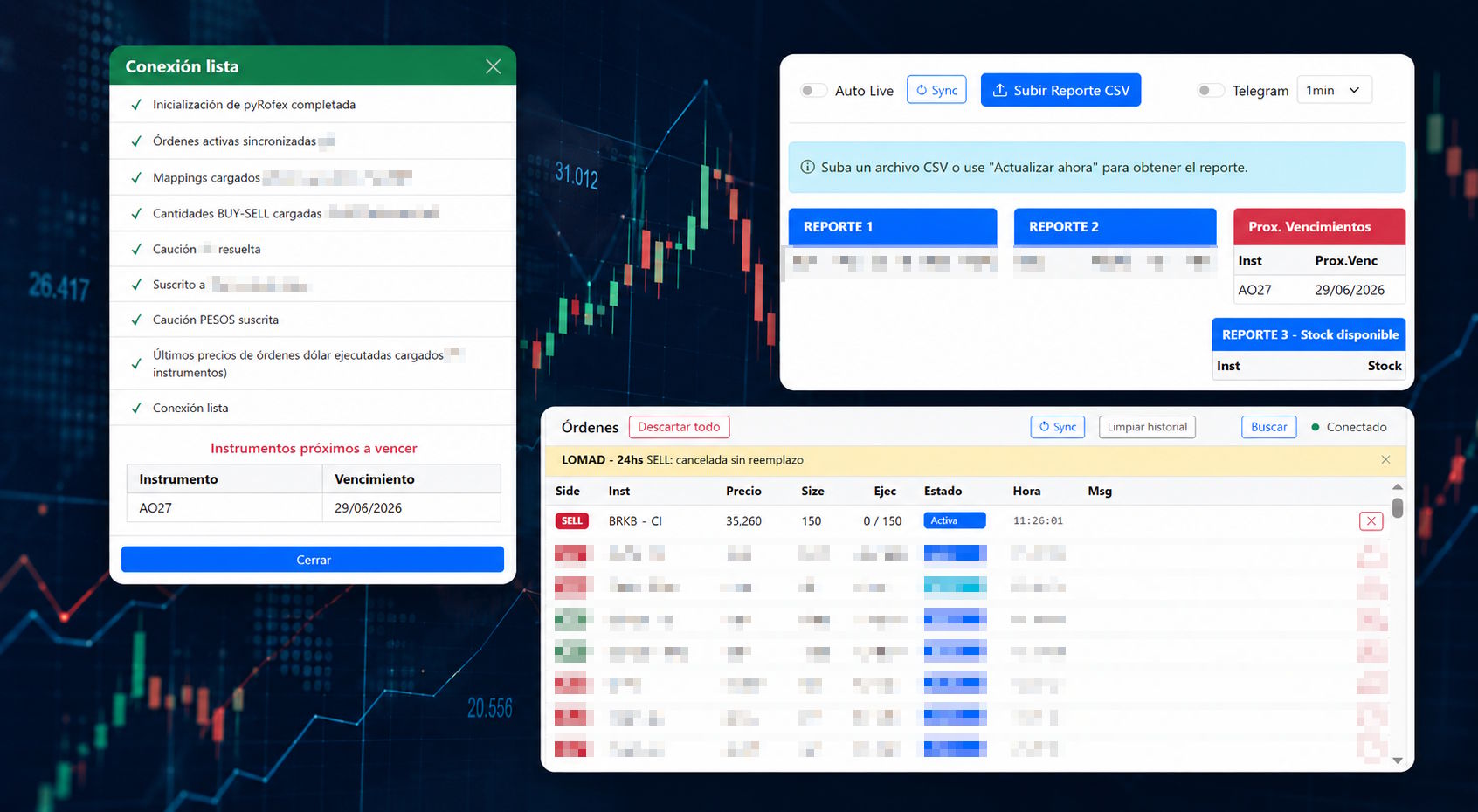
Market Operations
- Order placement, cancellation and replacement
- Real-time spreads and implicit rates
- Price capture for orders
- Support for CEDEARs, stocks, bonds, T-bills and cauciones (Argentine repos)
Smart Automation
- Automatic order replacement on market changes and specific parameters
- Caución (Argentine repo) management
- Bulk order placement and cancellation
Full-stack application designed and developed covering the full project cycle: trader workflow discovery with a real user, modeling, application architecture, full-stack implementation and hardening against live failure modes (latency, disconnects, multi-tab consistency).
Stack
- Backend: Python + Django 6.0 + Django REST Framework
- Broker client: pyRofex 0.5 (WebSocket + REST over Matba Rofex)
- Frontend: React 19 + Vite 7 + React Router 7, Bootstrap 5
- Real-time: Server-Sent Events (SSE) + BroadcastChannel API
- External integrations: Telegram Bot API (notifier)
- Database: SQLite
- Configuration: python-dotenv (.env), dev/testing/prod separation via DJANGO_ENV
Security & live trading safeguards
- Broker credentials and external tokens managed via
.env, outside the repository - CORS restricted via django-cors-headers;
ALLOWED_HOSTSand sensitive settings conditioned byDJANGO_ENV - Two-step pre-submit validation: active broker connection check plus a per-instrument lock that rejects concurrent requests on the same order
- WebSocket receiver thread isolation: work is offloaded to background queues to avoid losing market ticks
Application architecture
- Modularized backend by domain: connection, calculations engine, price capture, order routing, cauciones, and live account reports
- "One feature → one app" rule: the module owning the state also owns its lifecycle, and others mutate it via lazy import
- Frontend organized by layers:
contexts/for per-domain global state,services/for SSE wrappers and REST clients,pages/with their subcomponents andcomponents/only for truly shared code
Internal design patterns
- Broker session dispatcher: broker read functions automatically pick pyRofex when WebSocket is up and fall back to REST otherwise, with transparent re-auth on 401
- Multi-tab SSE with BroadcastChannel: a single tab holds the real EventSource, others receive via BroadcastChannel with leader election and failover, avoiding duplicate broker connections
- Atomic order replacement: cancel → wait → place → wait with WebSocket confirmation and bounded retries on recoverable errors
- Per-frame coalescing of market ticks to avoid saturating the browser: ~2000 updates per second are consolidated into ~60 UI refreshes, eliminating cascade re-renders under load
- Pre-market price capture via in-memory timer at close and deferred persistence on disconnect, avoiding unnecessary intermediate writes
Highlighted features
- Real-time calculations computed server-side and streamed via SSE
- Order auto-replacement on market or spread changes, with WebSocket confirmation and explicit user-facing failure surfacing
- Caución (Argentine repo) management
- Live account report and Telegram daemon
Web application for comprehensive real estate management. It centralizes property information and facilitates financial control and deadline tracking.
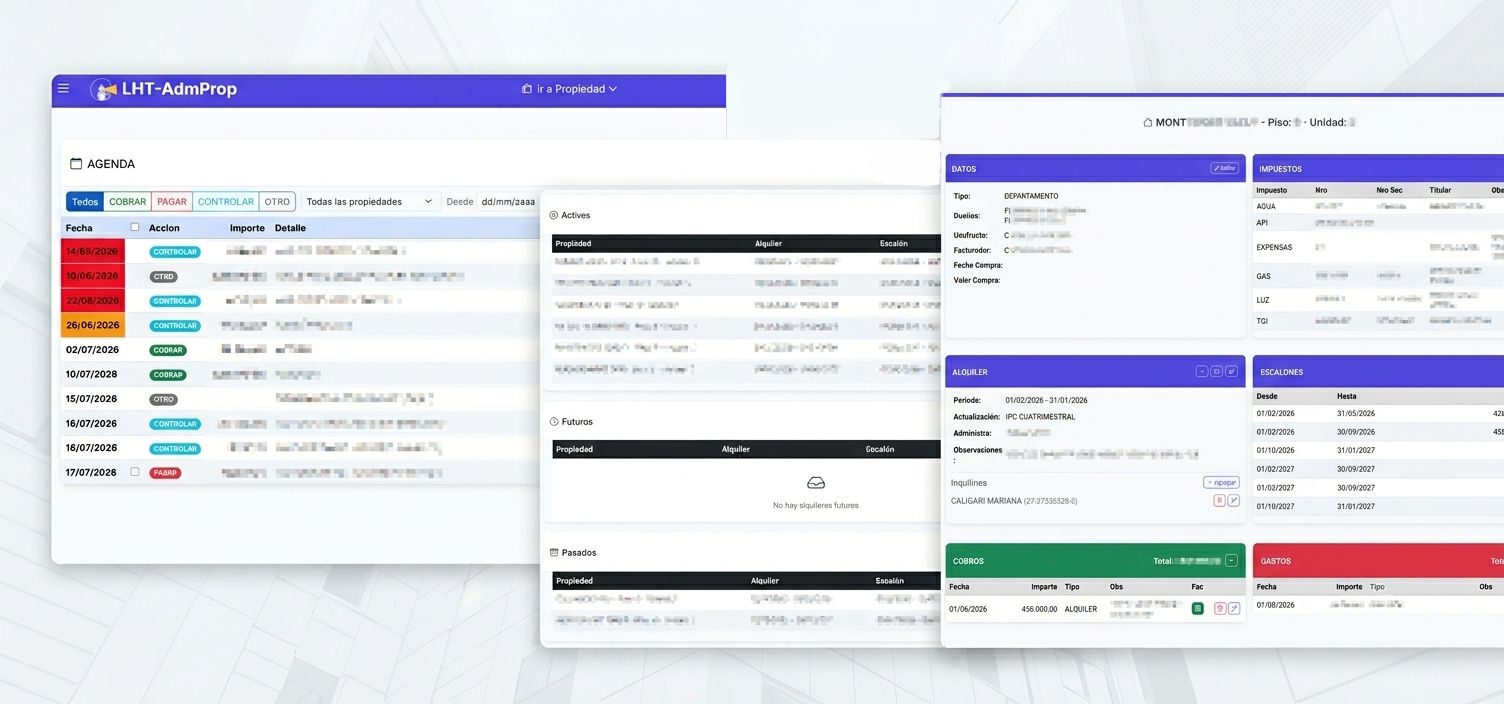
Centralized Information
- Quick access to each property's data
- Tax, rental, payment, and expense records
- Complete financial history per property
Schedule & Control
- Tax and payment deadline tracking
- Rental income and other revenue monitoring
- Clear visibility of each property's financial status
Internal web application for comprehensive real estate administration, built end-to-end: business discovery with real users, modeling, application architecture, full-stack implementation, security hardening, and deployment.
Stack
- Backend: Python + Django 6.0
- Database: MySQL in production, SQLite in development
- Frontend: Bootstrap 5.3, Bootstrap Icons, Inter font, vanilla JavaScript (Django SSR + interactive JS)
- Authentication: django-otp (TOTP 2FA), qrcode, Pillow
- Configuration: python-dotenv (.env), dev/prod separation via DJANGO_ENV
Security & authentication
- Mandatory 2FA via django-otp (TOTP, compatible with Google Authenticator)
- Custom middleware:
LoginRequiredMiddleware(global mandatory login, no per-view decorators) andSingleSessionMiddleware(one active session per user; logging in from another device closes the previous one) - Production hardening: SSL redirect, HSTS (1 year, subdomains, preload), secure and HttpOnly cookies, SameSite=Lax, CSRF trusted origins, strict ALLOWED_HOSTS
- Self-service flows: password reset by email and "contact admin" requests
- Custom admin panel (
CustomAdminConfig); secrets kept outside the repository (.env)
Application architecture
- Project modularized into apps by business domain: core (base, utilities, mixins, record locking), userAuth (auth, OTP, profile, custom admin), parameters, realestates (operational core)
- View sub-packages in
realestates/views/(realestate.py,rent.py,finances.py,agenda.py,helpers.py) to group related concerns - Context processors (
company_information,realestate_nav) inject company data and navigation into every template
Internal design patterns
- Standardized CRUD with shared helpers (
ajax_save,ajax_delete,form_initial_json) centralizing validation, IntegrityError handling and messages - Generic base template (
parameter_list.html) that each CRUD extends by overriding blocks - Concurrency: generic
RecordLock(ContentType-based) preventing simultaneous edits without blocking reads UppercaseFieldsMixinfor data normalization at the model level- Reusable domain validations (e.g.
validate_cuitfor Argentine CUIT)
Highlighted features
- Property-centric model: properties, taxes, rents, tenants, expenses, collections and bills, with a complete financial history per property
- Rent management with escalation steps and overlap prevention for active contracts
- Agenda with deadline tracking and color-coded rows by proximity (overdue / due today / due soon)
- Idempotent
sync_rent_agendamanagement command that generates each month's rent-collection entries automatically - Post-login alert for expiring contracts